James Hardie New Detached ADU: The Austin Owner’s Guide
We stock and install James Hardie siding, trim, and weather barrier products for new detached ADUs across Austin, with typical installed siding packages running $14,000 to $28,000 depending on ADU size and Hardie product line. Most owners reach out after a failed inspection or a siding blow-off during a spring storm, and we can usually schedule a materials walkthrough within three to five business days. You’ll know it’s time to call when you see cracked lap siding near the bottom edge, visible gaps at trim joints, or water staining on the interior drywall after a heavy Austin rain.
What you’re dealing with isn’t just a cosmetic problem. James Hardie products fail differently in Central Texas than they do in, say, Seattle. Our freeze-thaw cycles, long stretches of direct sun, and those May hailstorms put stress on fasteners and flashing that a spec sheet won’t warn you about. Ben Ortega has walked enough Austin lots to know exactly where these failures start, and it’s rarely where the homeowner first looks.
Which James Hardie Models This Applies To
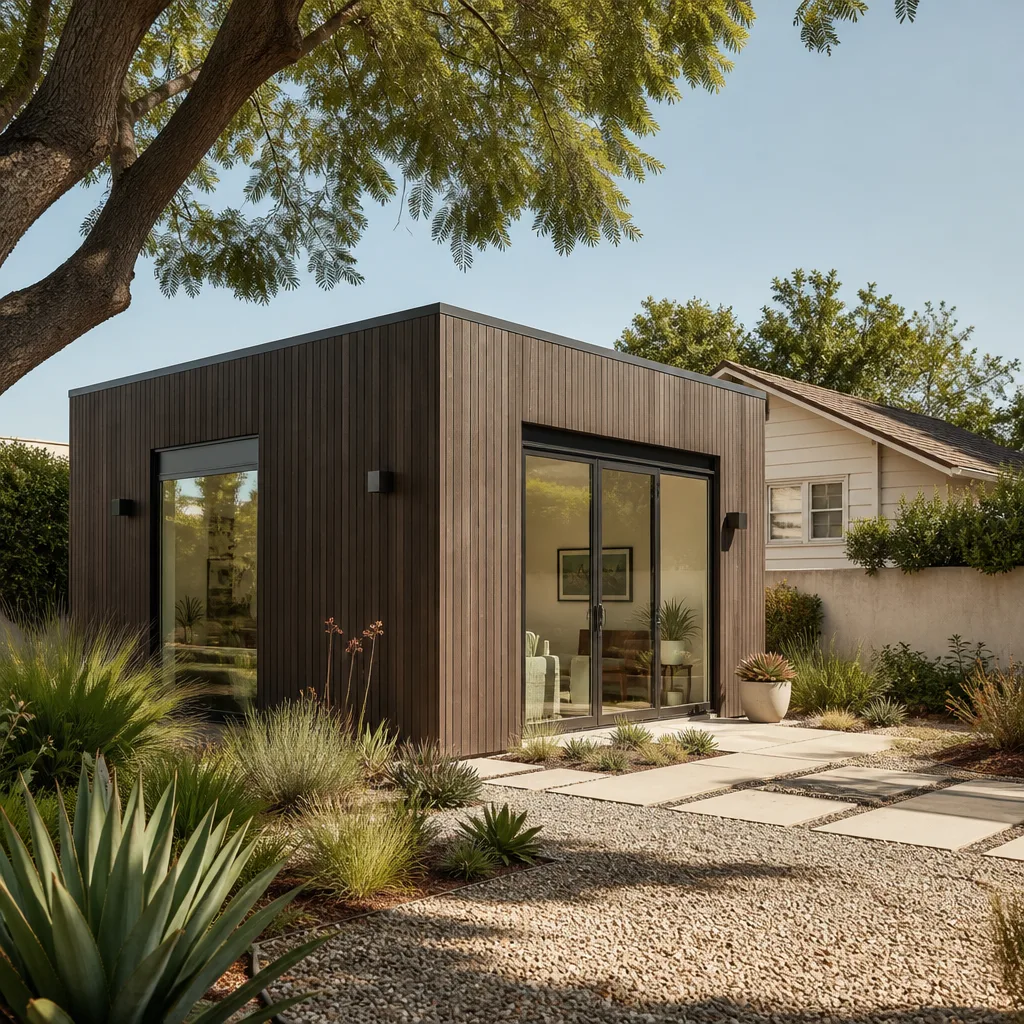
If you’re building or repairing a new detached ADU in Austin, you’re almost certainly working with one of three James Hardie product families: HardiePlank lap siding, HardiePanel vertical siding, or HardieTrim boards. The compatibility issue most owners miss is that HardiePlank comes in multiple exposure widths (4″, 5″, 6″, 7-1/4″, and 8-1/4″), and you cannot mix exposures on the same elevation without the joints telegraphing through the paint. Measure the visible lap width before you order anything.
For Austin ADUs specifically, we recommend HardiePlank in the 6-1/4″ or 8-1/4″ exposure paired with HardieTrim in the 5/4″ and 4/4″ profiles. The wider exposures handle our thermal swings better, and the thicker trim resists the warping we see on narrow 1x boards after a few Texas summers. If the existing siding is failing, we always check whether the original installer used the correct 6d hot-dipped galvanized nails. We find electro-galvanized nails on maybe one in five Austin ADUs we inspect, and that’s a guaranteed premature failure point.
On OEM versus aftermarket: for structural siding and trim, stick with genuine James Hardie. The aftermarket lap siding products don’t carry the same 30-year limited warranty, and the color-match from batch to batch is noticeably inconsistent. For the weather barrier underneath, we stock both HardieWrap and Tyvek, and there are quality aftermarket options there that perform identically for less money. Ask us before you buy.
Signs Your James Hardie New Detached ADU Is Failing
- Visible gaps at trim-to-siding joints. HardieTrim expands and contracts with humidity swings. When the original installer butted joints tight instead of leaving the required 1/8″ gap and caulking properly, the joint opens up and water gets behind the siding. This is the most common failure we see on Austin ADUs built between 2018 and 2022.
- Bottom-edge cracking on the first course of lap siding. This usually means the siding was installed too close to grade. James Hardie requires 6″ minimum clearance above finished grade. On sloped Austin lots in neighborhoods like Crestview, we regularly find the low corner sitting 2″ above soil with wicking damage climbing up three or four courses.
- Nail pops showing through the face of the siding. Hardie products are heavy. When the installer used a pneumatic nailer at too high a pressure, the nail head countersinks through the face and loses holding power. The first strong north wind will rattle those courses loose.
- Interior drywall staining on the ADU’s west-facing wall. West walls in Austin take the full force of afternoon sun and drive rain. If the housewrap seams weren’t taped with a Hardie-approved tape, water sneaks through at exactly the seam locations. The staining usually appears as vertical shadow lines spaced about four feet apart.
- Paint that won’t stay bonded, especially on the south exposure. Hardie’s ColorPlus finish is factory-applied and should last 15 years. If you’re seeing peeling or chalky dust within three to five years, the original installer likely used a latex paint over bare Hardie without the proper alkali-resistant primer. That’s a re-prep and repaint, not a quick touch-up.
Replacement Cost & What’s Included
A full James Hardie siding replacement on a new detached ADU in Austin typically runs $14,000 to $28,000 installed. A partial repair, which is what most failing ADUs actually need, lands between $3,500 and $8,000 depending on how many elevations are affected and whether we’re pulling the existing siding or working with what’s sound.
Here’s what that includes, line by line:
- Materials: James Hardie lap siding or panels, HardieTrim, and either HardieWrap or Tyvek weather barrier at $4 to $7 per square foot depending on product line and profile.
- Labor: Removal of failed siding, inspection of the framing and housewrap underneath, re-flashing around windows and doors, and proper installation with correct fasteners at $6 to $10 per square foot.
- Flashing and trim accessories: Drip edge, Z-flashing at horizontal joints, and corner trim at $800 to $2,000 for a typical 400 to 800 square foot ADU.
- Paint and primer: If we’re doing unpainted Hardie, factor $2,000 to $4,500 for primer and two topcoats. ColorPlus panels eliminate this line item but cost more per square foot upfront.
Every Seedling ADU Austin quote is written before any work starts. You’ll see the siding line items, the labor, the flashing, the paint, all of it. No surprise change orders after the crew shows up. That’s not how we operate, and Ben’s name is on the estimate.
And if the work isn’t done right, the 365-Day Done Right Promise applies. We make it right, in writing, for a full year after we finish.
DIY or Call Us?
Let’s be honest about what’s safe for a homeowner and what isn’t. Removing and reinstalling James Hardie siding is not a spring-tension situation. No one is going to get seriously hurt replacing a lap board. But it’s not a weekend project either. Hardie board is heavy, and a 12-foot plank dropped on a foot will break it. The bigger issue is invisible damage. If you pull off a failed course and find the housewrap underneath is also failed, you now have an open wall on a humid Austin day with rain possible in the forecast, and you’re racing the clock with no backup plan.
What you can safely do: document the damage with photos, mark the worst sections with painter’s tape, and clear the area around the ADU so a crew can set up scaffolding or ladders without moving your garden beds. What we handle: everything else, including the flashing corrections and the grade clearance fixes that most Austin ADUs need anyway.
If you’re on the fence, call us at (254) 615-3842. We’ll talk through what you’re seeing and tell you straight whether it’s a small job or a full re-side.
FAQs
James Hardie siding should last 30 to 50 years on an Austin ADU when it’s installed with proper clearances, correct fasteners, and painted or pre-finished the way the manufacturer specifies. The products that fail early, and we see this on ADUs across Austin, are almost always the result of installation errors from the first build, not defects in the Hardie material itself. Call (254) 615-3842 if you’re seeing early cracking or joint separation, and we’ll tell you what’s actually going on before we quote anything.
Most of the time we can repair a section rather than replace the whole wall. If the failure is isolated to one elevation or a few courses near grade, we match the exposure and profile, swap the damaged boards, correct whatever caused the failure (clearance, flashing, or fastener issues), and blend the paint. Full-wall replacement is only necessary when the water damage has migrated behind the housewrap or the framing shows rot. Ben will walk you through what he sees before any work is approved.
A partial siding repair on an Austin ADU typically takes two to four working days from tear-off to final paint touch-up, weather permitting. Full re-siding jobs run one to two weeks. We’ll set the schedule before we start, and we’ll show you the cleanup photo before the crew leaves each day. Shoe covers and drop cloths are standard on every visit if the ADU is already occupied.
We keep the most common James Hardie profiles and trim widths on hand, including 6-1/4″ HardiePlank, 5/4″ and 4/4″ HardieTrim, and both HardieWrap and Tyvek. ColorPlus pre-finished panels are ordered per job since color batches vary and we don’t want to hand you a mismatch. For homeowners who want to compare ADU systems before committing, we also work with Abodu, Cover, and Dvele, and we’ll help you decide whether a full prefab ADU makes more sense than repairing what’s on your lot now.
Written by Ben Ortega, Owner, Seedling ADU Austin at Seedling ADU Austin, serving Austin and nearby areas.