James Hardie Garage Conversion ADU: The Austin Owner’s Guide
James Hardie siding and trim on a garage conversion ADU in Austin typically costs $1,850 – $4,200 to repair or replace when sections fail, and we carry the common profiles and colors on our trucks for same-week installation. Most Austin homeowners discover a problem the same way: a corner of HardiePlank has started to swell after a heavy rain, or the HardieTrim around a window has pulled away from the wall and left a gap you can see from the driveway. The good news is that matched James Hardie material is available locally, and we can usually get a crew out within days, not weeks.
We’re Seedling ADU Austin, an independent ADU and garage conversion builder. We install and repair James Hardie siding and trim on the ADUs we build, and we also fix failing Hardie material on existing garage conversions across Austin, from Crestview to Mueller to Circle C. We’re not affiliated with James Hardie Corporation, but we’ve worked with their products long enough to know exactly what fails in Texas heat and how to fix it without making the rest of the wall look patched.
Which James Hardie Models This Applies To
Most garage conversions in Austin use one of three James Hardie product lines: HardiePlank lap siding (the classic horizontal board, usually 5/16″ thick in Texas), HardiePanel vertical siding (common on modern ADU designs, 4×8 or 4×10 sheets), and HardieTrim boards (smooth or woodgrain, used around windows, doors, corners, and the garage door opening that gets infilled during a conversion). Each line has its own fastener requirements and exposure limits, and mixing them up causes exactly the kind of failures we get called to fix.
The quick way to identify your product: look at the back of a loose piece or the exposed cut edge. HardiePlank lap siding will show a smooth, cement-like core with visible fiber texture. HardiePanel has the same core but comes in sheets, not boards. HardieTrim is denser and smoother than lap siding, and it’s often used as a single board running vertically beside a window or door. If you’ve got the original contract or material invoice from your conversion, look for the color name (James Hardie uses names like Cobble Stone, Monterey Taupe, and Timber Bark) and the product code. That code tells us the exact color and finish so we can match it without visible seams.
For replacement material, we recommend OEM James Hardie product rather than generic fiber cement. The color match is tighter, the warranty stays intact, and the dimensional consistency means the new board sits flush with the old one. Generic fiber cement is cheaper on the shelf, but we’ve seen too many Austin garage walls where a “close enough” color turned into a patchwork panel visible from the street.
Signs Your James Hardie Garage Conversion ADU Is Failing
- Swelling or buckling at board ends. Fiber cement absorbs water when the factory edge seal is cut during installation and never re-sealed. In Austin’s heavy spring rains, water wicks into the cut end and the board swells. You’ll see it first at the bottom course near grade, where splash-back keeps the cut edge wet longer.
- Gaps opening around windows and the old garage door opening. The original garage door infill wall is framed differently from the rest of the structure, and it settles at its own rate. HardieTrim boards nailed tight to that infill will pull away from adjacent siding as the framing moves, leaving a gap that grows wider each summer.
- Chalky white residue running down from trim boards. This is efflorescence, minerals leaching out of the cement core when water moves through the board. It means water is getting behind the siding more often than it should, usually because of missing or failed flashing at the top edge of a trim board.
- Hairline cracks radiating from fastener heads. James Hardie requires specific nail patterns and nail types. When a board was over-driven or nailed too close to the edge, the cement cracks around the nail head. Over a few Austin seasons of thermal expansion, those cracks become visible and let water into the wall cavity.
- Paint peeling only on certain boards, not others. If your ADU was painted after siding installation and the adhesion is failing on a patchwork of boards but not others, those boards were likely installed while wet or were contaminated with dust before painting. The board itself may still be sound, but the fix usually means removing paint, re-priming, and repainting, not replacing the Hardie product.
Replacement Cost & What’s Included
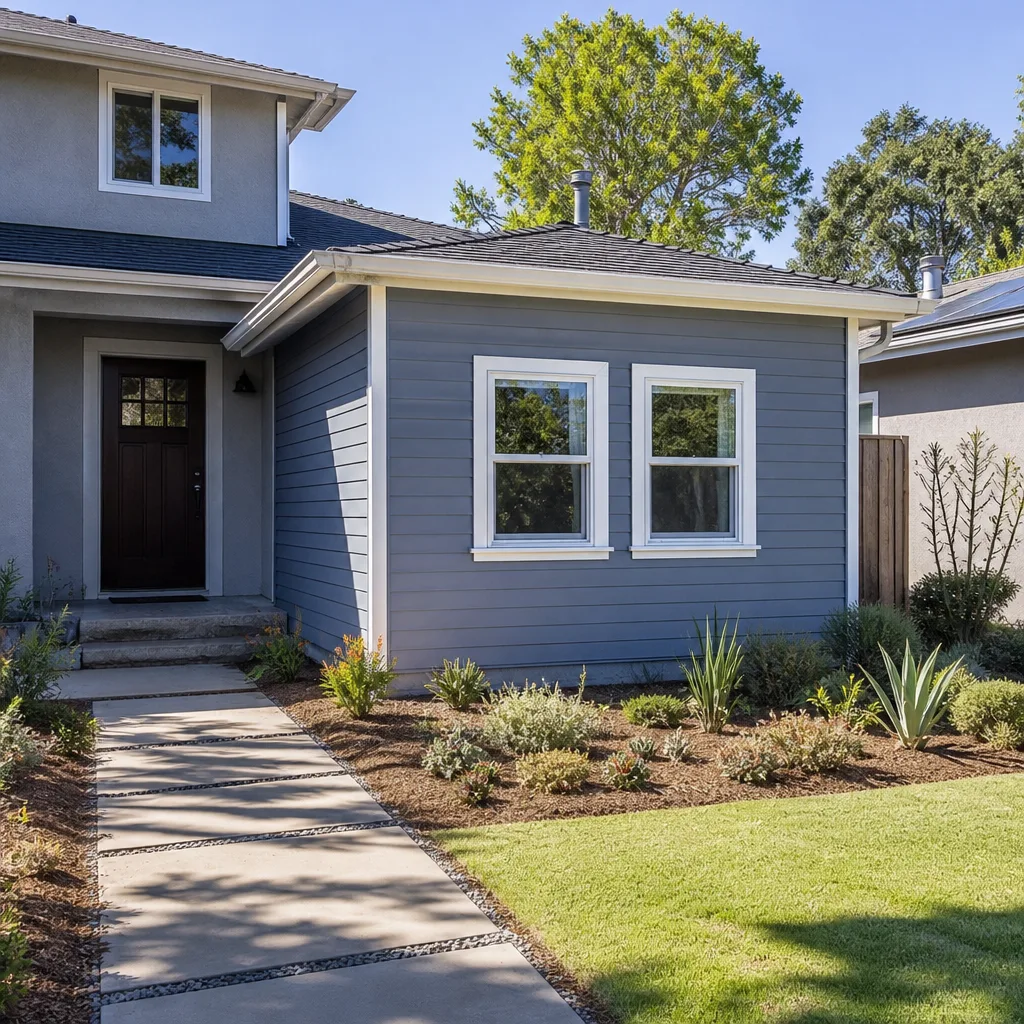
For an Austin garage conversion ADU, expect to pay between $1,850 and $4,200 for a typical James Hardie repair job that includes removal of damaged boards, flashing correction if needed, new OEM Hardie material installed to manufacturer spec, and paint-matched finish work. Smaller jobs, like replacing two or three damaged lap siding boards on one wall, usually land at the lower end. Larger jobs, like re-trimming every window on a 400-square-foot conversion plus repainting the affected walls, push toward the higher end.
What drives the price: how many boards are damaged, whether the original flashing was installed wrong and needs correction, and whether the color match requires a custom paint blend. We write the price down before work starts, and that’s the price you pay. No change orders when we find rotted framing behind the siding and have to sister in a new stud. That’s what the quote is for. Every repair is covered by our 365-Day Done Right Promise: if it’s not right, we make it right.
We also honor the Cedarwell Care Promise on every job site. That means shoe covers and drop cloths any time we’re inside the ADU, pet-safe products where there’s a choice, and a photo of the clean-up before the crew leaves. If you’ve got a baby napping inside, we’ll work quietly near that wall and tell you before we start cutting.
DIY or Call Us?
You can safely check a few things on your own. Walk the perimeter after a rain and look for the swelling or gaps described above. Tap suspicious boards with a knuckle: a solid thock means the board is okay, a dull thud means the core is compromised. Take photos of what you find and keep them for reference. What you shouldn’t do is pull boards off yourself. Fiber cement is heavy, the dust is silica-based and not something you want in your lungs, and behind that board you may find framing damage that requires a permit to repair properly in Austin.
Also remember: James Hardie products carry a warranty, but only if the product was installed according to the manufacturer’s nail pattern, flashing detail, and clearance specs. If you tackle the repair without following those specs, you’ve likely voided the warranty on the entire wall. If you’d rather not spend a weekend doing wall surgery on your ADU, call us at (254) 615-3842. Ben Ortega will walk you through what needs to happen and what it costs, before anything gets scheduled.
FAQs
James Hardie siding and trim typically lasts 30 to 50 years in Austin’s climate, but that assumes it was installed correctly and the cut edges were sealed. We regularly see Austin garage conversions where poor flashing shortens that to 8 to 12 years before boards start failing. The product itself is sound; it’s the installation details that determine lifespan. If you’re seeing failures early, call (254) 615-3842 and we’ll tell you exactly what went wrong.
Small cracks and chips can be patched with a fiber-cement-rated exterior filler, but swelling, delamination, or water damage cannot be repaired. Once the cement core has absorbed water and expanded, the board’s structural integrity is gone and patching just hides the symptom. We’ll tell you honestly which category your damage falls into when we look at it.
Most repairs on a garage conversion ADU take one to two days, including removal, replacement, flashing correction, and paint matching. Larger jobs involving multiple walls or full re-trim can take three to four days. We’ll give you a schedule in writing before we start, so you know which days the crew will be on your lot.
We stock common HardiePlank lap siding profiles, HardiePanel sheets, and HardieTrim boards in the colors most often used on Austin ADUs, along with a range of newer sizes like the wider 7-1/4″ exposure boards. If your color or profile isn’t on the truck, we can source it from local James Hardie distributors within a few days. We’ll confirm availability before we schedule your repair.
Written by Ben Ortega, Owner, Seedling ADU Austin at Seedling ADU Austin, serving Austin and nearby areas.